The classic kitchen-lighting mistake looks like this: a homeowner installs eight identical 6” wafers in a tidy grid across the ceiling, flips the switch, and finds shadows on the prep counter, a dim spot over the island, a 5000K daylight color that makes raw chicken look gray, and a sink corner that picks up steam the fixtures weren’t rated for. They blame the lights. The lights aren’t the problem. The problem is that “kitchen lighting” is three or four different jobs — prep task, island accent, ambient fill, over-sink damp — and no single fixture spec does all of them well.
That’s the framing for this guide. We’re going to walk through the four zones a kitchen ceiling actually contains, then match a fixture to each zone, with two or three honest cons on every pick. Beam angle, CRI, CCT, and damp rating matter more in a kitchen than in any other room — and the comparison table below flags them as separate columns for a reason.
If you’re not sure whether you need canless or retrofit at all — or if your project is outside the kitchen — start with our full LED recessed lights guide, which walks through the six install categories and ten picks across rooms. This post assumes you already know you want recessed lights in a kitchen and you’re trying to spec the right ones.
One disclosure up front. We haven’t tested these in a lab. Nobody who writes one of these articles has, including the big sites that imply they did. What we have done is read patterns in thousands of buyer reviews, dig into spec sheets, and cross-check against what electricians actually recommend on the trade forums. When we say “buyers consistently report shadows on the counter,” we mean that pattern shows up across hundreds of reviews — not that we hooked one up to a meter.
Which kitchen zone are you lighting?
Four buckets. Most kitchens need fixtures from two or three of them, not one.
Bucket K1 — Prep counter / cutting board task. The two-to-four fixtures directly over the spot where you actually do knife work. This is the most demanding zone in the kitchen. You want CRI 90 or higher (a real measurement, not a marketing claim), CCT in the 3000K–4000K range, 900–1200 lumens per fixture, a wide-ish beam around 90° so overlapping cones kill shadows on the counter, and a dimmable driver for evening cleanup. If you skip CRI here, chicken looks pink-gray, peppers look muddy, and herbs look brown. This is the zone where buyers spend the most and regret it least.
Bucket K2 — Island / accent. If you have a kitchen island, this zone is its own animal. A standard 6” canless wafer at 110°–120° beam angle throws a diffuse wash that bleeds across the whole ceiling — your island top reads the same brightness as your floor, which produces zero visual emphasis and reads as “the lights are too dim over the island.” The fix isn’t more lumens. It’s a narrower beam (38°–60°) or a tighter aperture (a 4” gimbal with an adjustable tilt) that creates a defined pool of light. Pendants over the island can stay; this is additive.
Bucket K3 — General ambient ceiling fill. The rest of the kitchen ceiling — circulation paths, the dining-adjacent area, the corners away from the prep zone. You want even fill, IC-rated (kitchens almost always have insulation above), CCT-selectable so it matches the prep zone, at least 1000 lumens per fixture, a wide ~120° beam for spread, and a quiet driver. The high-ceiling variant of this bucket — vaulted, cathedral, or open-plan kitchens with 10–12 ft ceilings — needs more than a standard wafer can deliver. Light falls off with the square of the distance, so a wafer that’s perfect at 8 ft is visibly dim at 12 ft. For that case you want 1500+ lumens per fixture and an 8” aperture so throw distance still puts usable light on the counter.
Bucket K4 — Over-sink / damp-adjacent. The one or two fixtures directly above the sink, especially under a window. This is splash and steam territory. Damp-rated is the minimum; wet-rated (IP65) is required if there’s any spray path — and a sink with a pull-down spray faucet under a low window is the classic wet-rated case. Sealed lens, not exposed driver. CCT should match the rest of the kitchen ceiling or the eye will pick up the mismatch even when buyers can’t articulate why the kitchen “feels off.”
Optional fifth zone: smart-zoned / scenes. If you want a “cooking” scene at 4000K full lumens, a “dinner” scene at 2700K dimmed 40%, and a “cleanup” scene at 3500K full lumens on one tap, you want tunable white in at least two of the buckets above. RGB is mostly overkill in a kitchen — no one wants purple food. We include one smart pick below for buyers who want this, but only one or two zones in the kitchen need to be smart, not all of them.
If you’re between buckets, default to K3 (general ambient) for most of the ceiling, layer K1 (high-CRI prep) directly over the cutting board, K2 (narrow gimbal) over an island if you have one, and K4 (wet-rated) over the sink. That’s the kitchen-lighting plan in one sentence.
Comparison table
This table is kitchen-focused, with a Beam column we don’t carry in the general guide. For non-kitchen rooms — bathrooms, basements, smart RGB across the house, closets and hallways — see our broader recessed lights guide with ten picks across all six install buckets.
| # | Pick | Zone | Install | Lumens | CCT | Beam | Damp/Wet | Price |
|---|---|---|---|---|---|---|---|---|
| 1 |  TORCHSTAR Retrofit 12-Pack TORCHSTAR Retrofit 12-Pack |
Prep (K1) | Retrofit | 1100 | 5-CCT | ~90° | IC | $$$ |
| 2 |  Halo HLB6 6-Pack Halo HLB6 6-Pack |
Prep + Ambient (K1/K3) | Canless | 600/900/1200 | 5-CCT | ~110° | Wet | $$$ |
| 3 |  Lithonia WF6 Wafer Lithonia WF6 Wafer |
Ambient (K3) | Canless | 1050 | 3-CCT | ~110° | Wet · JA8 | $$$ |
| 4 |  Sunco 4" Gimbal 6-Pack Sunco 4" Gimbal 6-Pack |
Island (K2) | Canless gimbal | 750 | 5-CCT | ~38–45° | Damp | $$ |
| 5 |  Globe Electric Wet-Rated 4-Pack Globe Electric Wet-Rated 4-Pack |
Over-sink (K4) | Canless | 800 | 3000K | ~110° | IP65 wet | $$ |
| 6 |  HALO HLB8 8" High-Output HALO HLB8 8" High-Output |
Ambient (10 ft+) | Canless 8" | 1600 | 5-CCT | ~120° | Wet | $$$ |
| 7 |  Philips Wiz Smart 4-Pack Philips Wiz Smart 4-Pack |
Smart scenes (K5) | Canless smart | ~800 | RGB + tunable | ~110° | Dry/Damp | $$$ |
Pick 1 — TORCHSTAR 5/6” LED Retrofit Downlight, 12-Pack
Best for the prep counter and cutting board zone when you already have cans in the ceiling and food color matters.

TORCHSTAR Retrofit 12-Pack, E26 + 5-CCT
- Retrofit only — fits existing 5" or 6" cans (E26)
- 15W · 1100 lm · CRI 90+ (real) · ~90° beam · dimmable
- 5-CCT: 2700K–5000K · Energy Star · IC-rated
TORCHSTAR’s CRI 90 claim is the one in this category that actually holds up in independent measurement, which is exactly the spec you want over the cutting board. The honest test is whether raw food looks the right color when you’re prepping dinner — and at CRI 80–85, chicken reads pink-gray and herbs read brown. CRI 90+ fixes that, and TORCHSTAR is the most reliable retrofit on Amazon at this price point. Energy Star qualification matters in California, Massachusetts, and New York where utility rebates ($2–5 per fixture) only cover Energy Star units — material when you’re buying twelve. The 5-CCT switch on the back lets you dial 3500K or 4000K for the prep zone without committing at checkout.
The current SKU is a 12-pack, which is more than most kitchens need over just the prep counter — but you’ll use the spares elsewhere in the house, and the per-unit math doesn’t work as well in a 4-pack.
Watch out for. First, this is retrofit-only. If you don’t have existing cans over the prep counter — if you’re doing new construction or the ceiling is open — these fixtures cannot help you. A surprising number of returns happen because buyers miss this. Second, retrofits sit inside an enclosed can and run hotter than canless wafers, so real-world lifespan in poorly-vented older cans tends to come in under the marketing 25,000h figure. Third, per-unit cost is roughly 2x what a Sunco or Amico canless wafer costs in volume — if you have only two or three cans over the prep zone, the math is fine; if you’re trying to do the whole kitchen ceiling with these, the budget moves fast.
Pick 2 — Halo HLB6 6” Selectable Lumens + CCT, 6-Pack
Best workhorse for the whole kitchen ceiling when the ceiling is open — covers prep, ambient, and over-sink on a single SKU.
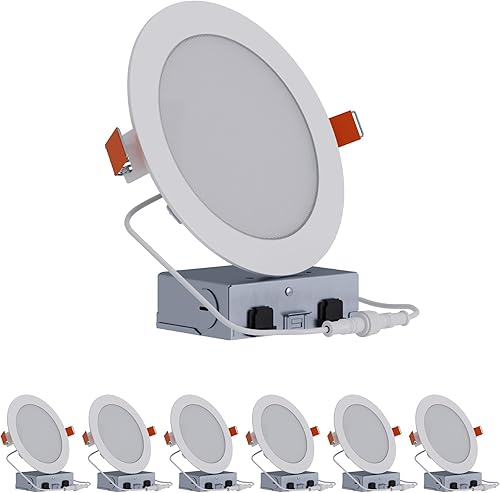
Halo HLB6 6-Pack, Selectable Lumens AND CCT
- Canless wafer · wet-rated · Energy Star · ½" profile
- Selectable lumens: 600 / 900 / 1200 · ~110° beam
- 5-CCT: 2700K / 3000K / 3500K / 4000K / 5000K · dimmable
The HLB6 is the workhorse of the kitchen ceiling. The selectable-lumens-and-CCT design means one SKU covers three zones: 1200 lm at 4000K over the prep counter, 900 lm at 3500K for general ambient fill, and 600 lm at 3000K for the dim dining-adjacent corners. Buyers don’t have to mix two or three SKUs to get zoned brightness — they buy one box, tune each fixture before clipping it in, and the kitchen reads as one room. Halo also publishes the cleanest dimmer-compatibility chart in the category, which removes the single most common source of post-install regret in kitchens (flicker on an old Lutron Diva). Wet-rated covers the over-sink position without a separate SKU. Flicker performance across the wafer category is hard to beat here.
Watch out for. Price is the biggest one — at roughly $25–35 per unit, an 8-to-12-fixture kitchen ceiling costs real money compared to Sunco or Amico equivalents. Second, Amazon stock is inconsistent. Halo sells heavily through Home Depot’s commercial channel and through electrical-supply distributors, so the Amazon SKU goes in and out of stock and “ships in 1–3 weeks” notices show up regularly. Check stock before you commit the whole kitchen to this fixture. Third, the 5-CCT switch on the back is fiddly with the fixture installed — set lumens and CCT before the ceiling clip engages, not after, or you’ll be fishing behind the wafer with a flashlight.
Pick 3 — Lithonia Lighting WF6 LED Wafer Downlight
Best for kitchen remodels where the drywall is open and you want code-strict build quality — and the only JA8-compliant option for California new construction.

Lithonia WF6 Wafer Downlight, 90 CRI
- Canless wafer · IC-rated · wet-rated · 5-yr warranty
- 13W · ~1050 lm · 90 CRI (real) · ~110° beam · dim to 10%
- 3-CCT: 3000K / 4000K / 5000K · Energy Star · JA8 / CA Title 24
This is the build-quality pick. For a kitchen reno where the drywall is open and you want the fixtures to last fifteen years without driver buzz or low-end flicker on a Lutron Caseta, the Lithonia WF6 is the answer. CRI 90 is real here — not a marketing number. JA8 compliance is mandatory for California new construction in kitchens, and Lithonia is the only fixture on this list a California inspector will pass without an argument. Outside of California, JA8 doesn’t matter for code — but the underlying build standard is the same: tighter driver tolerances, lower flicker, a 5-year warranty, and the quietest driver of any wafer we tracked. That last one matters in a kitchen where you sit at the counter for hours.
Watch out for. First, no 2700K option. The warmest setting is 3000K, which is appropriate for kitchens — but it means you cannot color-match into an adjacent 2700K dining room without a visible step at the doorway. If your kitchen opens into a warm-amber living space, plan the transition. Second, per-unit cost is 2–3x the Sunco wafers — at ten or twelve fixtures, the premium adds up. Third, three CCTs instead of five means less tuning range than Halo, Sunco, or TORCHSTAR. For a kitchen, three is fine; we flag it because buyers comparing spec sheets will notice.
Pick 4 — Sunco 4” Adjustable Canless Gimbal Downlight, 6-Pack
Best for the kitchen island when you want a defined cone of light instead of a diffuse wash.

Sunco 4" Adjustable Gimbal Canless 6-Pack
- Canless gimbal with J-box · ETL · adjustable tilt
- 8W · 750 lm · ~38–45° beam · dimmable
- 5-CCT: 2700K / 3000K / 4000K / 5000K / 6000K
Islands need a defined cone of light, not a wash. The standard 6” wafer at 110°–120° throws a broad diffuse beam that bleeds across the whole ceiling — the island top reads the same brightness as the floor, which means no visual emphasis on the actual prep zone. Buyers consistently report this as “lights are too dim over the island” when the real issue is beam angle, not lumens. A 4” adjustable gimbal at ~38–45° creates a focused pool that says the island matters here, and the eyeball tilt lets the installer compensate if the fixture isn’t perfectly centered over the island top. Set CCT to 3000K to match warm-wood island materials, and keep your pendants — this is additive, not a replacement.
Watch out for. First, beam angle is the spec the listing claims but rarely prints on the box. Buyers receiving a 4” “narrow flood” that turns out to be 60° will be disappointed — measure the claimed angle from the spec sheet, not the marketing photos, and bench-test one fixture before committing. Second, most 4” gimbals — including this one — are damp-rated, not wet. Not for over the sink. Keep these on the island only. Third, 4” drivers fit in a tighter housing than 6” wafers, and heat dissipation is worse — reported failure rates across the 4” gimbal category run slightly higher than full-size canless wafers. Bench-test every unit before cutting drywall.
Pick 5 — Globe Electric 91126 6” Wet-Rated Recessed, 4-Pack
Best over the sink, especially under a window — the wet-rated paperwork an inspector will accept without an argument.

Globe Electric 91126 Wet-Rated 4-Pack
- Canless wafer · IC + IP65 wet-rated · Energy Star
- 12W · 800 lm · ~110° beam · dimmable · frosted lens
- Fixed 3000K · 6.31" hole size
Over the sink — especially under a window where steam rises and the occasional spray hits the ceiling — wet-rated paperwork matters. Damp is the minimum for normal sink positions; wet (IP65) is what you actually want under a low window with a pull-down spray faucet, and it’s the only rating an inspector will accept above a direct splash path. Globe Electric 91126 is the cleanest IP65 paper trail on Amazon at this price tier. You can hand the spec sheet to the inspector without an argument, the 4-pack covers a typical sink zone plus a backup, 3000K is the right CCT for kitchens, and the frosted lens cuts the glare you’d otherwise see bouncing off a stainless basin.
Watch out for. First, fixed CCT at 3000K. If the rest of your kitchen ceiling is tuned to 3500K or 4000K, this one fixture will read warmer than its neighbors — pick your ceiling CCT first, then decide whether 3000K over the sink is acceptable as a deliberate accent or a problem. Second, sold only in 4-packs. For a single sink-zone fixture, that means three spares sitting in a closet. Third, 800 lm is mid-tier — for a deep sink under a low window in a tall room, one fixture alone won’t be enough; plan to pair with adjacent ambient fixtures to hit usable brightness on the basin.
Pick 6 — HALO HLB8 8” Selectable CCT High-Output Canless
Best for vaulted, cathedral, and open-plan kitchens with 10–12 ft ceilings, where standard 6” wafers under-light the counter from height.

HALO HLB8 8" Selectable CCT Canless
- 8" canless wafer · IC + wet-rated · Energy Star
- ~19W · 1600 lm · ~120° beam · dimmable (Lutron, Leviton)
- 5-CCT: 2700K / 3000K / 3500K / 4000K / 5000K
Vaulted, cathedral, and open-plan kitchens with 10–12 ft ceilings break the standard wafer math. Light falls off with the square of the distance, so a 6” wafer that puts a comfortable 30 footcandles on the counter at 8 ft drops to roughly 13 fc at 12 ft — visibly dim, and buyers read it as “the lights don’t work in this kitchen.” The HLB8 roughly doubles the output and goes to an 8” aperture so throw distance still puts usable light on the counter from height. The 5-CCT switch matters more in tall rooms than it does at 8 ft because color inconsistency across a vault is the second most common complaint after brightness — being able to set every fixture to the exact same notch keeps the room reading as one space, not three. Wet-rated covers the steam path that runs higher in open-plan layouts where the sink and the cathedral peak share air.
If your kitchen has standard 8–9 ft ceilings, the 6” HLB6 covered in our main recessed lights guide is the right call — the HLB8 is sized for vaulted and open-plan ceilings specifically.
Watch out for. First, cutout size is the install gotcha. An 8” hole is not a drop-in for an existing 6” can or wafer cutout — the drywall has to be enlarged, which means saw work and patching if anyone guesses wrong. Verify cutout diameter (HLB8 nominal cutout is ~8-1/4”) before ordering. Second, overkill below 9 ft. At standard 8-ft ceilings the HLB8 over-lights the room and forces the dimmer to run at 30% all the time — drivers don’t love that, and the per-unit cost is wasted. Reserve for 10 ft and up. Third, per-fixture price is roughly 2x the HLB6, and the 8” aperture reads as commercial-spec in a small kitchen — visually heavy if the ceiling isn’t tall enough to absorb it. Note: we link the Amazon search results rather than a single ASIN here because the specific HLB8 SKUs go in and out of stock weekly; the search routes you to whichever Halo HLB8 family member is in stock today, with Lithonia WF8 and similar 8” high-output alternates surfacing as backups.
Pick 7 — Philips Wi-Fi Wiz 5”/6” Color + Tunable White Recessed Kit, 4-Pack
Best for smart kitchen scenes (cooking / dinner / cleanup) without committing to a Philips Hue ecosystem and hub.

Philips Wi-Fi Wiz 5"/6" Recessed Kit, 4-Pack
- 5"/6" canless recessed kit · ETL · Alexa + Google
- 65W equivalent · color + tunable white · dimmable
- Wi-Fi 2.4 GHz (no hub) · Wiz app scene support
Tunable white is the actually-useful smart feature in a kitchen. The use case is real: a “cooking” scene at 4000K full lumens, a “dinner” scene at 2700K dimmed to 40%, and a “cleanup” scene at 3500K full lumens, all one tap away. RGB ships with these too, but kitchens mostly don’t want it (no one wants purple food). The Philips Wiz line is the credible non-Lumary path on Amazon — same parent brand as Hue, lower price tier, no hub purchase, scenes are programmable in the app, and the 4-pack covers a small ambient zone on a single SKU instead of forcing a multi-brand split-brain setup.
Smart recessed is a broader category than the kitchen scenes use case — for the full RGB / hub-vs-no-hub / Philips Hue tradeoff we walked through Pick 9 in our main recessed lights guide.
Watch out for. First, the Wiz app is not the Hue app. Buyers consistently report occasional re-pairing required after router reboots, and the scenes UI is fiddlier than the screenshots imply. If you already live in Hue, you’ll be frustrated; if you’re new to smart lighting, Wiz is fine. Second, 2.4 GHz Wi-Fi only. Modern mesh networks that auto-steer between bands cause setup pain — the fixture won’t pair when your phone is on 5 GHz. Pin the phone to 2.4 GHz during pairing, then switch back. Third, CRI on the tunable-white mode lands around 80, not 90. Adequate for ambient and scene use, not great for the primary prep zone over the cutting board. Reserve these for ambient or island positions and keep Pick 1 or Pick 2 over the actual prep counter.
Kitchen recessed mistakes buyers actually make
Reading review patterns across the kitchen recessed category, the same seven mistakes show up over and over. None of them are stupid — the category doesn’t surface these distinctions clearly.
1. Wrong beam angle for the island. A standard 6” canless wafer throws ~110°–120°, which is a broad wash. Over an island, that produces no visual emphasis at all — the island top reads the same brightness as the floor. Islands want a narrower flood (~38°–60°) or a tighter aperture (4” gimbal) to create a defined cone. Buyers consistently file this as a “too dim over the island” complaint when the actual issue is beam angle.
2. Buying CRI 80 fixtures for the prep zone. CRI under 90 makes chicken look gray, peppers look muddy, and herbs look brown. For the two-to-four fixtures directly over the cutting board and prep counter, push for CRI 90+ from a brand with a measurement track record (TORCHSTAR, Halo, Lithonia). For ambient fill across the rest of the kitchen, CRI 82–85 is fine and saves money.
3. Skipping damp-rated near the sink. A dry-rated fixture directly over a sink picks up steam and the occasional splash. Driver corrosion shows up 12–24 months later as flicker or buzz that buyers blame on the dimmer. Damp-rated minimum over the sink; wet-rated (IP65) if there’s any splash path or a window with condensation directly above.
4. Mixing CCTs across the kitchen ceiling. A 3000K over the sink, a 3500K over the prep counter, and a 4000K over the island will read as visibly mismatched. The eye picks it up even when buyers can’t articulate why the kitchen “feels off.” Pick one CCT for the kitchen ceiling (3000K or 3500K most common) and hold it across all fixtures. CCT-selectable fixtures help — but only if every fixture is set to the same notch.
5. Spacing too far apart for task coverage. Rule of thumb: ceiling height ÷ 2 = maximum fixture spacing for general ambient (8 ft ceiling = 4 ft spacing max). For the prep counter zone, tighter — closer to ceiling height ÷ 3 — so overlapping beams kill shadows on the counter. Buyers routinely install one fixture every 6 ft and end up with shadowy gaps over the cutting board.
6. Dimmer compatibility — buzz, flicker, dim-floor. Same root cause as in the broader guide, but kitchens make it worse. You’re at the counter for hours, and a 120Hz flicker that’s tolerable in a hallway becomes a headache here. Use CL-rated dimmers (compatible with CFL and LED). Halo, Lithonia, and TORCHSTAR all publish dimmer compatibility charts — actually consult them. Older Lutron Diva incandescent dimmers from 2005–2015 are the single most common culprit when an otherwise-good kitchen install flickers.
7. Trusting the listing’s “kitchen” tag. Most Amazon recessed listings that show “kitchen” in the title or bullets are generic ambient fixtures with kitchen photography in the carousel. They’re not task-optimized — they’re 80 CRI, 110° beam, fixed 4000K wafers that happen to have a kitchen image. The “kitchen” tag is marketing, not a spec. Verify CRI, CCT, beam angle, and damp rating independently of the listing’s room claim.
Quick recommendations by zone
- For your prep counter / cutting board: Pick 1 (TORCHSTAR retrofit) if you have existing cans, or Pick 2 (Halo HLB6) at 1200 lm / 4000K if the ceiling is open. Both are real CRI 90.
- For your island / accent zone: Pick 4 (Sunco 4” gimbal) at 3000K. Tilt the gimbal toward the island top after install. Pendants stay; this is additive.
- For general ceiling fill (the rest of the kitchen): Pick 2 (Halo HLB6) for the mid-tier flexible pick, Pick 3 (Lithonia WF6) for code-strict or premium builds.
- For vaulted or open-plan kitchens (10 ft+): Pick 6 (HALO HLB8). 1600 lm and an 8” aperture so the counter still gets usable light from height. Reserve for 10 ft and up.
- For over the sink: Pick 5 (Globe Electric 91126 wet-rated). The paperwork the inspector wants.
- For smart scenes (cooking / dinner / cleanup): Pick 7 (Philips Wiz). Tunable white is the useful smart feature; skip the RGB.
- For California new construction (Title 24): Pick 3 (Lithonia WF6) is the only JA8-compliant option on this list.
This guide gets you to the right fixtures for the right zones. It doesn’t yet cover the layout side — where exactly to put each fixture, how to space them for a specific counter run, and what to do when a joist sits where a fixture needs to go. That’s a separate post we’re working on. If you’re stuck on layout before you cut drywall, drop the question in the comments and we’ll prioritize the one with the most interest.
Buy honest. Light the kitchen you actually cook in, not the showroom version. And measure twice.