Most “best recessed lights” articles fail you in the first paragraph. They rank a single pick at the top and assume you already know whether you need a canless wafer, a retrofit insert, or a bulb. Those three things are not interchangeable, and buying the wrong one is the most expensive mistake in this category — not because the lights are pricey, but because you’ll order a 12-pack, open one, realize it doesn’t fit your ceiling, and then have to repackage eleven boxes for return.
Here’s the confusion in plain terms. A canless (also called wafer or ultra-thin) recessed light is the fixture itself — it ships with a junction box, you wire it directly into the ceiling, and there is no “can” anywhere. A retrofit recessed light is an insert that screws into an existing can’s light-bulb socket using an E26 adapter; if you don’t already have cans in your ceiling, retrofit kits are useless to you. A BR30 bulb is just a bulb that fits the existing socket in older cans with no kit at all — the cheapest path, but it leaves the visible old trim ring.
Pick the wrong category and nothing else matters. So before we get to product names, we’re going to walk through six buyer buckets and help you self-diagnose which one you’re in. Then — and only then — we’ll hit the ten picks, with at least two honest cons on each one. Because every recessed light has tradeoffs. Anyone telling you their pick is perfect for everyone is selling you something.
One more thing up front. We haven’t tested these in a lab. Nobody who writes one of these articles has, including the big sites that imply they did. What we have done is read through the patterns in thousands of buyer reviews, dig into spec sheets, and cross-check against what electricians actually recommend on the trade forums. When we say “buyers consistently report flicker on Lutron Diva incandescent dimmers,” we mean that pattern shows up across hundreds of reviews — not that we hooked one up to a meter.
Let’s figure out which type you need.
Which type of recessed light do you actually need?
Six buckets. Find yours.
Bucket A — New construction or full ceiling install. You’re finishing a basement, framing an addition, or your kitchen drywall is open. You want canless ultra-thin wafers with built-in junction boxes, IC-rated for direct insulation contact, and you want them in volume packs of 12 or 24 because per-unit price matters. CCT-selectable (a switch on the back that lets you pick the color temperature) is almost mandatory now so you don’t lock yourself in before you’ve lived in the room.
Bucket B — Retrofit into existing cans. Your house was built between roughly 1995 and 2015 and has BR30 incandescents or old CFL kits in 5” or 6” cans. The cans stay. You want an E26-base retrofit insert that drops into the existing housing. Critical: measure the inside diameter of the can, not the trim ring. 4”, 5”, and 6” cans look identical from below and are not interchangeable.
Bucket C — Kitchen task lighting. You want 900–1100 lumens per fixture, 3000K to 4000K color temperature, CRI 90 or higher so your food and your countertops don’t look gray, and confirmed dimmer compatibility. Beam angle matters more here than in any other room — narrow beams leave dark zones on the counter. If kitchens are your whole project, we have a dedicated zone-by-zone guide for prep counters, islands, ambient fill, over-sink, and vaulted ceilings: see our kitchen-specific recessed lighting picks →.
Bucket D — Bathroom, shower, or any wet location. This is where code matters. Damp-rated is not wet-rated. Damp is legal in a bathroom ceiling away from the spray zone. Wet (IP65 or higher) is required directly over a tub or shower. Inspectors check this. Many Amazon listings say “bathroom safe” and are only damp-rated — that’s a code issue if it’s over the shower.
Bucket E — Closet, hallway, or low-ceiling space. You need the slimmest profile you can find (under half an inch is achievable now), 400–700 lumens is plenty, and 4” aperture is often a better fit than 6”. The driver should be quiet — closets amplify buzz.
Bucket F — Smart, app-controlled lighting. Real talk: most people who get deep into smart lighting end up on Philips Hue, which is sold direct and through Home Depot rather than dominating Amazon. Amazon’s smart-recessed shelf is Sunco, Lumary, and a handful of Chinese-brand WiFi units. If you want full RGB and don’t want a hub, there’s a credible Amazon option below. If you want rock-solid reliability across a whole house, look at Hue separately.
If you’re between buckets, default to A (canless) if your ceiling is open, and B (retrofit) if it isn’t. Everything else is a refinement.
Comparison table
Kitchen project? This table covers all six install buckets across rooms. For zone-by-zone kitchen picks (prep, island, ambient, over-sink, vaulted), jump to our kitchen-specific recessed lighting guide →.
| # | Pick | Install | Size | Lumens | CCT | Wet | Price |
|---|---|---|---|---|---|---|---|
| 1 |  Sunco 6" Slim 12-Pack Sunco 6" Slim 12-Pack |
Canless | 6" | 850 | 5-CCT | IP65 | $$ |
| 2 |  Ensenior 6" Ultra-Thin 12-Pack Ensenior 6" Ultra-Thin 12-Pack |
Canless | 6" | 1200 | 5-CCT | IP44 | $$ |
| 3 |  TORCHSTAR Retrofit 12-Pack TORCHSTAR Retrofit 12-Pack |
Retrofit | 5"/6" | 1100 | 5-CCT | IC | $$$ |
| 4 |  Amico 6" Canless 24-Pack Amico 6" Canless 24-Pack |
Canless | 6" | 1050 | 5-CCT | IP65 | $ |
| 5 |  Lithonia WF6 Wafer Lithonia WF6 Wafer |
Canless | 6" | 1050 | 3-CCT | Wet · JA8 | $$$ |
| 6 | 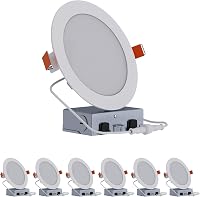 Halo HLB6 6-Pack Halo HLB6 6-Pack |
Canless | 6" | 600/900/1200 | 5-CCT | Wet | $$$ |
| 7 |  LUXRITE 4" 12-Pack LUXRITE 4" 12-Pack |
Canless | 4" | 750 | 5-CCT | Damp | $$ |
| 8 |  Sunco BR30 Bulb 6-Pack Sunco BR30 Bulb 6-Pack |
Bulb only | E26 BR30 | 850 | 2700K | Dry | $ |
| 9 |  Lumary Smart RGBWW 4-Pack Lumary Smart RGBWW 4-Pack |
Smart canless | 6" | 1000 | RGB+CCT | IP65 | $$$$ |
| 10 |  Globe Electric Wet-Rated 4-Pack Globe Electric Wet-Rated 4-Pack |
Canless | 6" | 800 | 3000K | IP65 | $$ |
Pick 1 — Sunco Lighting 6” Slim LED Downlight, 12-Pack
Best for basement and whole-floor canless installs where price-per-unit matters but you still want IP65.

Sunco 6" Slim Canless 12-Pack, 5-CCT
- Canless wafer with J-box, ~1" depth, ETL
- 14W · 850 lm · IP65 wet · dimmable
- 5-CCT: 2700K / 3000K / 4000K / 5000K / 6000K
Sunco is the default everyone-buys-first canless wafer on Amazon for a reason — at twelve units in a pack, the per-unit price lands somewhere most other ETL-listed brands can’t touch, and the 5-CCT switch on the back means you can install all twelve, then walk the house and tune temperature room by room without re-ordering anything. The IP65 rating is real (Sunco publishes the test paperwork), which means these are legal in bathroom ceilings, including outside the direct shower zone.
The pack also includes an adapter clip set for dropping these into existing 5” or 6” cans, which makes it a sneaky decent Bucket B pick if your cans are standard size.
The tradeoffs. Driver QC is the weak link. Across large packs, buyer reviews consistently flag a 3–5% DOA or early-failure rate — call it one bad unit per 12-pack on average. Sunco’s customer service is responsive about replacements, but you need to test all twelve before you cut drywall around them. Second issue: flicker on older Lutron Diva incandescent dimmers shows up repeatedly in reviews. If you have not-yet-replaced incandescent dimmers, plan to swap them. Third: the CRI is nominally 90 but amateur measurements put it closer to 82–85, which is fine for most rooms but not enough for kitchens where you care about food color.
Pick 2 — Ensenior 6” Ultra-Thin LED Recessed Light, 12-Pack
Best for new construction where you want more lumens than Sunco at a similar price — and you are not lighting a shower.

Ensenior 6" Ultra-Thin Canless 12-Pack, 5-CCT
- Canless with J-box clip system, ETL
- 12W · 1200 lm · IP44 damp (NOT wet) · dimmable
- 5-CCT: 2700K / 3000K / 3500K / 4000K / 5000K
On paper Ensenior beats Sunco on lumens per watt at roughly the same price, and the J-box clip design is cleaner — installers consistently call it faster than Sunco for a first-time DIYer. If you’re lighting a basement, a den, a stairwell, or any ambient-light scenario where you want a brighter wafer for the money, this is the pick.
The CCT switch covers the same range as Sunco. Build feels slightly nicer in hand. There’s a 4” SKU in the same family if your closet or hallway scope creeps in mid-project.
Watch out for. The big one is the IP rating. These are IP44 — damp-rated, not wet-rated. That means they’re legal in a bathroom ceiling away from the spray zone, but not above the tub or shower. The listings can be ambiguous about this and buyers get burned routinely — somebody installs eight of these in a master bath, the inspector flags the two over the shower, and now there’s a return. Second issue: some Ensenior SKUs start at 3000K and don’t include a 2700K option, which is the warmest setting most buyers actually want for living rooms. Check the back-switch labeling before you order.
Pick 3 — TORCHSTAR 5/6” LED Retrofit Downlight, 12-Pack
Best for replacing old BR30 bulbs in existing cans when color accuracy matters — especially kitchens.

TORCHSTAR Retrofit 12-Pack, E26 + TP24
- Retrofit only — fits existing 5" or 6" cans (E26 or TP24)
- 15W · 1100 lm · CRI 90+ (real) · dimmable
- 5-CCT switch · Energy Star · IC-rated · baffle metal trim
TORCHSTAR is the answer to a specific question: you’ve got existing cans, you don’t want to tear into the ceiling, and you care about how food and skin look under the light. This is the retrofit pick where the CRI 90 claim actually holds up in independent measurements. It’s an Energy Star-certified unit, which matters in California, Massachusetts, and New York where utility rebate programs only cover Energy Star fixtures — you can sometimes get $2–5 back per fixture from your utility, which materially changes the math.
The current SKU is now CCT-selectable across five temperatures (2700K–5000K), so you don’t lock yourself into one color at checkout.
The tradeoffs. First, this is retrofit-only. If your ceiling doesn’t already have cans with E26 sockets, this product cannot help you, full stop. Plenty of returns happen because buyers don’t read the fine print. Second, per-unit cost is roughly 2x what the Sunco/Ensenior canless wafers cost in volume packs, so if you have eight cans and don’t care about CRI, the math may favor a cheaper option plus a Hue bulb for the one fixture over a counter. Third, retrofit installs run hotter than canless wafers because they sit inside an enclosed can — lifespan in poorly-vented cans is typically shorter than the marketing claim.
Pick 4 — Amico 6” Canless Recessed Light, 24-Pack
Best for whole-house or whole-basement installs where you need 20+ units and absolute lowest cost-per-fixture.

Amico 6" Canless 24-Pack, 5-CCT
- Canless with J-box, IC-rated, ETL+FCC
- 12W · 1050 lm · IP65 · dimmable 5–100%
- 5-CCT: 2700K / 3000K / 3500K / 4000K / 5000K
If you’re lighting a full basement (typical: 18–24 fixtures), the 24-pack from Amico lands the lowest per-unit price among ETL-listed Prime-eligible canless wafers we tracked. It’s roughly comparable to Sunco on lumens, CCT range, and IP rating. For a budget-driven big install, it does the job.
The tradeoffs. Quality control is the biggest variance on this entire list. Reddit and Amazon reviews consistently report one to two units per 24-pack failing within six months — the failure rate is higher than Sunco, which is already not great. Plan on bench-testing every unit before cutting holes. Second issue: driver buzz on some dimmer brands, especially older Lutron incandescent dimmers and a few cheap TP-Link smart dimmers. Third: Amico’s customer service is noticeably slower than Sunco’s — getting a replacement takes longer and asks for more documentation. If you’re a contractor on a deadline this matters more than the per-unit savings.
Pick 5 — Lithonia Lighting WF6 LED Wafer Downlight
Best for California new construction (or any inspection-strict install) where Title 24 / JA8 compliance is required.

Lithonia WF6 Wafer Downlight, 90 CRI
- Canless wafer · IC-rated · wet-rated
- 13W · ~1050 lm · 90 CRI · dim to 10%
- 3-CCT: 3000K / 4000K / 5000K · Energy Star · JA8 / CA Title 24
Lithonia is the only pick here that a California inspector will pass without an argument. JA8 compliance is a specific California building code requirement for high-efficacy lighting in new construction, and most of the Amazon-dominant brands don’t carry it. If you’re permitting work in CA, this is essentially mandatory in most rooms. Outside CA, JA8 doesn’t matter for code — but the underlying quality bar is the same: tighter driver tolerances, quieter operation, lower flicker, and a 5-year warranty vs. Sunco’s 3.
The build is genuinely the best on this list. If you hold a Sunco wafer in one hand and a Lithonia in the other, the difference is obvious — better heat-sink, more solid trim, less plastic flex. CRI 90 here is real, not marketing.
The tradeoffs. Price is 2 to 3x the Sunco unit cost. At small scale (4–8 fixtures) the premium is easy to absorb. At 24+ fixtures, it adds up to real money. Second issue: no 2700K option. The warmest setting is 3000K, which reads visibly cooler than incandescent — in a living room with warm wood floors and incandescent table lamps, the difference is noticeable. If you’re going for that classic warm-amber look across the room, this isn’t it.
Pick 6 — Halo HLB6 Selectable Lumens + CCT, 6-Pack
Best for kitchens and rooms where you want maximum flexibility on lumens and color after install — you can re-tune both without swapping fixtures.
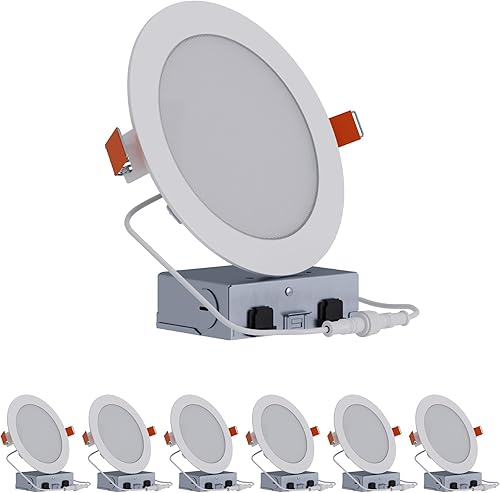
Halo HLB6 6-Pack, Selectable Lumens AND CCT
- Canless wafer · wet-rated · Energy Star · ½" profile
- Selectable lumens: 600 / 900 / 1200
- 5-CCT: 2700K / 3000K / 3500K / 4000K / 5000K · dimmable
The Halo HLB6 is the most flexible spec sheet on this entire list — both lumens and color temperature are switchable on the fixture after install. That means a single SKU works for an ambient bathroom (600 lm, 3000K), a kitchen task install (1200 lm, 4000K), or a dim hallway (600 lm, 2700K). For a homeowner who’s not sure exactly how bright they want a room until they’re standing in it, this removes a category of regret.
Halo also publishes the best dimmer-compatibility chart in the industry — they explicitly list which dimmers flicker, which work at 10% floor, and which buzz. That document alone is worth the premium because it lets you buy the right dimmer instead of guessing. Flicker performance on this unit is the cleanest of any wafer on this list.
The tradeoffs. Price is the biggest one — at ~$25–35 per unit, a basement worth of them costs real money. Second, availability is inconsistent. Halo sells heavily through electrical-supply distributors and Home Depot’s commercial channel, so the Amazon SKU goes in and out of stock and “ships in 1–3 weeks” notices are common. If you’re on a deadline, check stock before committing the whole project to this fixture.
Pick 7 — LUXRITE 4” Ultra-Thin LED Recessed, 12-Pack
Best for closets, hallways, and any low-ceiling space where a 6” aperture is overkill or won’t fit.

LUXRITE 4" Ultra-Thin Canless 12-Pack
- Canless wafer · IC-rated · damp-rated · ETL + Energy Star
- 10W · 750 lm · 0.5" profile · dimmable
- 5-CCT: 2700K / 3000K / 3500K / 4000K / 5000K
The 4” form factor is genuinely hard to find in volume packs at a reasonable price, and LUXRITE fills that gap right now. For closets, hallways, narrow stairwells, and rooms where you want a row of accent lights rather than full-power ambient lighting, 4” is the right call. The half-inch depth makes these fit in shallow ceiling cavities where a 6” wafer can’t physically go. 750 lumens is plenty for a closet or hallway — overspec here and you’ll squint when you turn them on.
The tradeoffs. Damp-rated only — these are NOT legal directly over a shower or tub. For bathroom ceilings outside the spray zone they’re fine, but if you need wet-rated, jump to Pick 10. Second, the 4” aperture means narrower beam spread and less overall room coverage — these are task or decorative fixtures, not ambient. If you try to light a 12x14 living room with eight 4” units, the room will read as patchy. Use 6” for ambient, 4” for accent. Third: brighter than the HYPERLITE 4” most lists feature (which is currently out of stock on Amazon), but the driver is louder under some dimmers — pair with a Lutron Caseta or Leviton CL-rated dimmer to keep it silent.
Pick 8 — Sunco BR30 LED Bulb 6-Pack (Soft White)
Best for the cheapest possible upgrade when your existing cans already have working E26 sockets and you don’t want to install anything.

Sunco BR30 LED Bulb 6-Pack, 2700K
- Bulb only · E26 base · BR30 · UL listed
- 11W (65W equiv) · 850 lm · dimmable 10–100%
- Fixed 2700K soft white (3000K / 4000K / 5000K SKUs available)
If your house already has working cans with E26 sockets and the trim looks fine, you don’t need a retrofit kit — you just need bulbs. A 6-pack of these BR30 LEDs costs less than a single retrofit insert, installs in 30 seconds per fixture, and gets you 80–90% of the energy savings of a full retrofit. For renters, for a quick refresh before a house sale, or for a homeowner who just wants to stop paying for incandescents without spending a Saturday on it, this is the pragmatic choice. The 2700K SKU is the right call for almost any residential room.
The tradeoffs. These are bulbs, not fixtures. Some buyers don’t like the visible bulb shape behind the existing trim ring — it looks like a bulb, because it is one. If your trim is dated 1990s brass, swapping the bulb doesn’t fix the trim. Second issue: fixed CCT. You pick 2700K (warm) or another temperature at the cart and you’re done. No tuning. 5000K in a living room reads as parking-garage lighting, so be deliberate about which SKU you pick.
Pick 9 — Lumary Smart Recessed Lights (WiFi RGBWW), 4-Pack
Best for a smart-lighting setup on a budget where you want full RGB and tunable white without buying into a Philips Hue ecosystem.
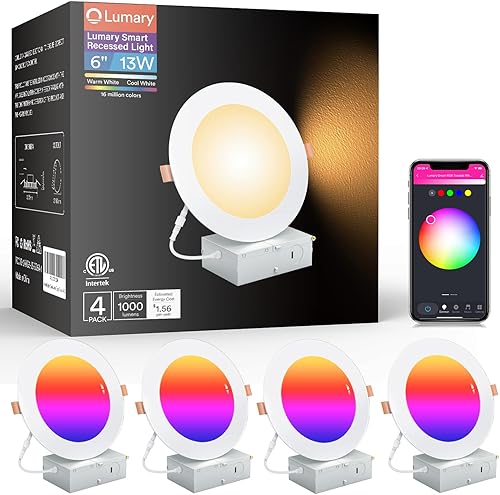
Lumary Smart Canless RGBWW 4-Pack
- Canless with J-box · ETL listed · Alexa + Google
- 13W · 1000 lm · WiFi 2.4 GHz (no hub) · dimmable 1–100%
- 16M colors + tunable white 2700K–6500K · IP65
If you want recessed lights that can shift from warm white at dinner to cool white in the morning to soft purple on game night — and you don’t want a Hue hub on your network — Lumary is the only volume-pack option on Amazon doing this credibly. The app is meaningfully better than the no-name competitors. The white quality is acceptable, not great. The RGB is genuinely good for accent/mood lighting. For most buyers, four units is the right pack size — RGB recessed is an accent in one or two rooms, not a whole-house system.
The tradeoffs. The 2.4 GHz-only WiFi is the biggest practical issue. Modern mesh networks that auto-steer devices between 2.4 and 5 GHz will routinely kick these off the network during setup, and the troubleshooting fix is to temporarily disable the 5 GHz band on your router — which is annoying and not obvious. Plan for an hour of network fiddling. Second issue: white CRI is around 80, which is fine for ambient but not great for kitchens or anywhere food rendering matters. Third: these are made by a Chinese brand with opaque data practices typical of the category — if you’re privacy-conscious, isolate them on a guest VLAN.
Pick 10 — Globe Electric 91126 6” Wet-Rated Recessed, 4-Pack
Best for the spot directly over a shower or tub where you legally need IP65 and the inspector will check the paperwork.

Globe Electric 91126 Ultra-Slim 4-Pack
- Canless wafer · IC + wet-rated · Energy Star
- 12W · 800 lm · dimmable · frosted lens
- Fixed 3000K · 6.31" hole size
When you specifically need a wet-rated fixture over a shower — not damp-rated, wet-rated — and you want to hand the inspector a spec sheet without an argument, this is the cleanest paper trail on Amazon. The 4-pack is the right scale for a typical 1- to 2-bathroom install. Globe Electric also sells a baffle-trim variant (SKU 91226) if you want the glare-reduction look in a smaller bathroom — same wet rating, just a different finished aesthetic.
The tradeoffs. Fixed CCT at 3000K. If your bathroom vanity is at 2700K and your overhead lights are at 3000K, the color mismatch will read as off — be deliberate about matching. Second issue: sold only in 4-packs, so an eight-light master bath needs two boxes — the math gets less friendly than buying a 12-pack of Sunco. Third: 800 lumens per unit is mid-tier — if you want a bright, hotel-feel master bath, you’ll need to spec a few extra units to hit total lumen targets. Don’t try to under-light a bathroom with these.
Mistakes buyers actually make
Reading buyer reviews across all ten of these products, the same seven mistakes show up over and over. None of them are stupid — they’re easy to make because the product category does not make these distinctions obvious.
1. Canless versus retrofit confusion. This is the single most common return. Canless wafers replace nothing — they get wired directly into the ceiling and they include the junction box. Retrofit units screw into the existing E26 socket inside an existing can. If you have no cans, retrofit kits are paperweights. If you have cans you want to keep, canless wafers create a wiring problem because you’d have to remove the cans first. Decide which one you have before you order anything.
2. Wrong diameter on retrofit kits. 4-inch, 5-inch, and 6-inch cans look almost identical from below. The trim ring fools you. The only reliable measurement is the inside diameter of the can itself, with the trim removed. Pop the trim off one can with a flathead screwdriver, measure, then order.
3. Damp-rated where wet-rated is required. Damp-rated fixtures are legal in a bathroom ceiling outside the direct shower or tub spray zone. Wet-rated (IP65 or higher) is required directly above the shower or tub. Many Amazon listings say “bathroom safe” and mean only damp. Inspectors check. If you fail inspection because of this, you’re pulling fixtures out of finished drywall.
4. Dimmer incompatibility — buzz, flicker, dim-floor. LED recessed lights need LED-rated dimmers, usually marked “CL” (compatible with CFL and LED). Old incandescent rotary or slide dimmers from the 1990s and 2000s will often make LED fixtures flicker at low brightness, buzz audibly, or refuse to dim below 30%. Buyers blame the light. It’s almost always the dimmer. Budget $20–40 per switch to replace older dimmers as part of the project.
5. Color temperature mismatch. Color temperature is the single most under-thought spec. 2700K is warm, like incandescent, and is what you want in living rooms, bedrooms, and dining rooms. 3000K is warm-white and is right for kitchens and bathrooms. 3500K is neutral and works in home offices. 4000K is cool, appropriate for garages and laundry rooms. 5000K is daylight and reads as utility-grade — install it in a living room and the room will feel like a parking garage. If you can, buy CCT-selectable wafers and tune the room after install.
6. Ignoring CRI (color rendering index). CRI under 90 makes food look gray, skin look dull, and paint colors look wrong. Cheap units claim CRI 90 on the box and measure 80–85 in amateur tests. For kitchens, bathrooms with vanities, and anywhere you display art or care how food looks, push for CRI 90+ from a brand with a track record (TORCHSTAR, Halo, Lithonia). For ambient lighting in a basement or garage, CRI 80 is fine.
7. IC-rating in insulated ceilings. “IC” means insulation-contact rated. If your ceiling has blown-in or batt insulation that touches the fixture, the fixture must be IC-rated or you have a fire risk. Most modern wafer-style canless units are IC-rated by default, but verify on the listing — older retrofit kits and some imported brands are not.
We’re working on a full install guide that walks through each of these from a homeowner’s perspective — coming soon.
Quick recommendations by use case
- Building a basement or full new install → Pick 4 (Amico) if budget is everything and you’ll bench-test every unit, or Pick 1 (Sunco) if you want a slightly more reliable middle ground.
- California new construction or any code-strict permitted install → Pick 5 (Lithonia WF6). It’s the only JA8-compliant option here.
- Existing 6” cans and you want quality light → Pick 3 (TORCHSTAR retrofit) for CRI 90 and Energy Star rebates, or Pick 8 (Sunco BR30 bulbs) for the cheapest bulb-swap path.
- Kitchen task lighting where food color matters → Pick 6 (Halo HLB6) for full lumen and CCT flexibility, or Pick 3 (TORCHSTAR) if you’re retrofitting and CRI is the priority.
- Bathroom — anywhere outside the shower zone → Pick 1 (Sunco, IP65) for a tunable option, or Pick 6 (Halo).
- Directly over the shower or tub → Pick 10 (Globe Electric 91126 wet-rated 4-pack). Inspector-friendly paperwork.
- Closet, hallway, low ceiling, or 4” aperture needed → Pick 7 (LUXRITE 4” 12-pack). Damp-rated, not wet — keep out of direct shower zones.
- Smart home with full RGB and no hub → Pick 9 (Lumary). Plan on an hour of network setup.
What’s next
This guide gets you to the right product. It does not yet cover two things that matter for the actual install: dimmer compatibility (which brand of dimmer pairs with which fixture without flicker or buzz) and the install process itself for canless wafers — cutting holes, fishing wire, J-box clip technique, and what to do when you hit a joist where the fixture needs to go. Both are getting their own posts. If you’re about to start a project and you’re stuck on either question, drop it in the comments and we’ll prioritize the one with the most interest.
Buy honest. Light the room you actually live in, not the showroom version. And measure twice.