The most common dimmable-LED failure looks like this: a homeowner installs modern LED wafers, leaves the existing pre-2015 Lutron Diva incandescent dimmer in the wall because “the wall switch already dims,” and turns the lights on to a visible 120Hz flicker, an audible buzz coming from the wall plate (not the fixture), and a dim floor stuck at 30% when the listing promised 10%. The buyer returns the fixtures. The fixtures aren’t the problem. The dimmer is the problem. The buyer paid for both.
That’s the framing for this guide. Dimmer compatibility is the single most-mentioned “watch out for” across every wafer we’ve covered — flicker, buzz, dim-floor surprises, CCT shift at low brightness. The lights take the blame; the dimmer is almost always the cause. So this post is organized by dimmer scenario, not by room. We’ll walk through four buyer buckets (and one optional fifth), teach the TRIAC-vs-ELV distinction in plain language, then match six fixtures to those scenarios with two-to-three honest cons on every pick.
If you’re not yet sure whether you need canless or retrofit, start with our main LED recessed lights guide — this post assumes you’ve already picked your install type and you’re focused on dimmer pairing. For the kitchen-specific cut of the picks with zone-by-zone framing, see our LED recessed lights for kitchens guide.
One disclosure up front. We haven’t tested these in a lab. Nobody who writes one of these articles has, including the big sites that imply they did. What we have done is read patterns across thousands of buyer reviews, dig into spec sheets and published dimmer-compatibility charts, and cross-check against what electricians actually recommend on the trade forums. When we say “buyers consistently report 30% dim floors on legacy TRIAC,” we mean that pattern shows up across hundreds of reviews — not that we hooked one up to a scope.
Which dimmer scenario are you in?
Four buckets, plus one optional fifth. Most homes match exactly one.
Bucket D1 — Existing legacy dimmer staying in the wall. You’re replacing bulbs or retrofitting fixtures, but you’re not opening the wall to swap the dimmer. The dimmer was installed somewhere between 2005 and 2015 — most likely a Lutron Diva (non-CL) or a Leviton Decora rotary, both leading-edge / TRIAC, designed for incandescent loads. Often the homeowner doesn’t even know what dimmer they have; they just know the wall switch dims the lights. What matters here is a fixture with a published dimmer-compatibility chart that lists tested behavior on old TRIAC. Even the best fixture will show some artifacts on a 15-year-old dimmer; the goal is to pick the one that misbehaves least. Honest answer for this bucket: swap your existing dimmer to the Lutron Caseta starter kit and pair with Pick 1 or Pick 2 — the matched set is the gold standard, and Caseta is the post’s answer whenever the buyer is willing to spend an hour at the switch box. If you’re truly not, Pick 3 is your shot.
Bucket D2 — Fresh install with a smart dimmer. You’re wiring a smart dimmer at the same time as the recessed install — Lutron Caseta is the dominant choice, Leviton Decora Smart and TP-Link Kasa are the volume alternatives. You want app control, scene support, and Alexa/Google integration. What matters: a fixture whose published compatibility chart specifically names the smart-dimmer brand you’re using. Smart dimmers are ELV-class and dim LED loads cleanly — pairings rarely fail when both brands are mainstream. The trap is mixing fixture brands on a single smart dimmer (more on that in failure mode #7).
Bucket D3 — Commercial / 0-10V wiring. You’re a general contractor, a commercial-property owner, or a serious DIYer wiring a 0-10V control system from scratch. This is the answer in finished basements built to commercial spec, home offices, retail-conversion projects, and a small but real slice of high-end residential remodels. 0-10V is a separate low-voltage control pair pulled alongside line voltage — it costs more in conduit, wire, and labor, but dims to a true 0% with no flicker and no buzz.
Bucket D4 — Dim-to-warm / dim-to-dark feel. You specifically want the incandescent dimming feel — color temperature shifts from a neutral 3000K at full output down to a warm 1800K–2200K at the bottom of the dim range, mimicking a tungsten filament. This is the dinner-party / cozy-living-room buyer, often retrofitting after a previous LED install that “felt wrong when dimmed.” Standard LED at 10% is still 3000K, just dim — which the eye reads as cold. Dim-to-warm fixes that with an explicit CCT curve, and dim-to-dark fixtures take the dim floor down to a true 0.1–1% for restaurant- and theater-grade smoothness.
Bucket D5 — Smart-dimmer-paired tunable-white scenes. Optional fifth. If you want “evening” at 2200K dimmed 30%, “task” at 4000K full output, and “movie” at 2700K dimmed 10%, all on one tap, you want Wi-Fi tunable white fixtures — not just smart dimming a standard LED. RGB ships with the credible options but isn’t the point. The Philips Wiz kit below is what we’d put in.
The pairing rule of thumb: if the dimmer brand publishes a compatibility chart that includes your fixture brand, and the fixture brand returns the favor, the pairing will almost certainly work cleanly. Either brand missing the other? Expect flicker, buzz, or dim-floor surprises — not always, but often enough that you should bench-test one fixture before committing to the full ceiling.
LED dimmer types — the primer the listings won’t give you
This is the section that justifies the post existing. If you read nothing else, read this. Six concepts.
Leading edge (TRIAC) vs trailing edge (ELV) — the core distinction
Leading edge — TRIAC, phase-cut leading. The original dimmer technology. The dimmer “chops” the leading edge of each AC half-cycle, reducing the effective voltage delivered to the load. Designed for resistive loads — incandescent bulbs, halogens, fat-filament tungsten. The chopping is electrically noisy and the LED driver receives a jagged input waveform. LED drivers are switching power supplies and they don’t like jagged inputs. Result: visible 120Hz flicker, audible 60Hz buzz from the dimmer’s choke coil under load, and a high dim floor — the driver bails out below roughly 30%. Almost every pre-2010 dimmer in a residential wall is TRIAC.
Trailing edge — ELV, electronic low voltage. The modern dimmer technology for LEDs. The dimmer chops the trailing edge of each half-cycle, producing a much cleaner waveform for the LED driver to swallow. Quieter, smoother dim curve, and dim floor in the 5–10% range on most modern wafers. All Lutron Caseta, all Leviton Decora Smart, and any dimmer marked “ELV” or “for LED” is trailing edge or a hybrid that behaves like trailing edge under LED load.
Rule of thumb: if the dimmer in your wall was installed before 2015 and you didn’t specifically buy an LED-rated unit, assume it’s leading-edge TRIAC. Pop the wall plate, look at the side label, and confirm.
CL-rated dimmers — Lutron’s “for LED” certification
“CL” is Lutron’s marking for dimmers engineered to handle the lower minimum load and the switching-power-supply behavior of CFL and LED bulbs. Lutron Diva CL, Lutron Maestro CL, and Lutron Skylark Contour CL are the common CL units.
Critical, and the source of half the “I have a Lutron, why is it flickering” complaints: Lutron Diva CL and Lutron Diva (non-CL) look nearly identical on the wall plate. Same paddle, same dimmer slider, same finish. The CL version has “CL” in the model number on the side label; the non-CL version is the legacy incandescent unit. Homeowners assume their Diva is CL because Lutron is “the LED brand,” but a 2008 Diva is non-CL and is the wrong dimmer for an LED load. Check the model number on the side label. If it doesn’t say CL, ELV, or “for LED,” treat it as incandescent-only.
0-10V dimming — the commercial-grade option
0-10V is a low-voltage control signal carried on a separate pair of wires pulled alongside the line-voltage feed. The dimmer modulates the control voltage between 0V (off / minimum) and 10V (full output); the fixture’s driver reads that voltage and adjusts output accordingly.
The pros are real: dims to a true 0% with no flicker, no driver buzz, no dim floor, perfectly smooth across the entire range. Mixing-fixture-brand tolerance is high because the driver does the work, not the dimmer. The cons are also real: it requires a separate low-voltage control wire to every fixture (roughly 2x the wiring labor of line-voltage dimming), the compatible fixtures are commercial-spec at ~2x consumer-wafer pricing, and most consumer wafers don’t have a 0-10V driver option at all. 0-10V is the right answer in finished basements built to commercial spec, home offices, restaurant conversions, and commercial-residential hybrids. It’s not the answer for a one-room kitchen retrofit.
Smart dimmers — Caseta vs Leviton Decora Smart vs Kasa
Honest comparison, not a Lutron commercial.
Lutron Caseta is the gold standard for LED dimming smoothness in the consumer segment. Proprietary RF (Clear Connect) talks to a Caseta hub, then Wi-Fi from the hub out to the network. Compatibility charts are published and they’re thorough — Halo, Lithonia, TORCHSTAR, Globe Electric, Sunco all publish Caseta-tested data. If you’re buying a smart dimmer, the Lutron Caseta starter kit (hub + dimmer + Pico remote) is what we’d put in. Per-dimmer cost is mid-tier; the one-time hub cost is the only meaningful extra over the alternatives.
Leviton Decora Smart (Wi-Fi) is the next tier down. Direct Wi-Fi (no hub) or a hub-based version. Cheaper per dimmer, no hub-required line. Compatibility is good but not Caseta-tier — published charts exist but cover fewer fixture brands, and the dim curve is slightly less smooth at the very low end. Solid mid-tier pick.
TP-Link Kasa is the budget smart dimmer. Wi-Fi direct, no hub. Compatibility charts are weak — Kasa publishes a generic “works with most LED bulbs” claim and not much more. In practice it dims most wafers acceptably, but the low end is rougher and buzz reports on specific fixture pairings come up more often. Adequate for ambient zones; not what you want over a kitchen counter where you’ll sit for hours.
Bottom line: if you’re asking which smart dimmer to pair with an LED wafer, the answer is Caseta if budget allows and Leviton Decora Smart if it doesn’t. Kasa is the right pick only when smart-dimmer cost is the gating constraint.
Dim floor and dim-to-warm
“Dimmable” does not mean “dims to zero.” Most LED wafers stop dimming somewhere between 5% and 10% — below that, the driver either holds at the floor or snaps off entirely (drop-out). The listing says “dim to 10%” because 10% is the floor, not zero. Buyers reading “dimmable” assume incandescent behavior (smooth roll-off to dark) and are surprised.
Dim-to-warm is a separate spec from dim floor. Dim-to-warm fixtures shift CCT down as they dim — typically from 3000K at full output to 1800K–2200K at the bottom of the curve, mimicking how an incandescent bulb behaves (filament cools, light reddens). Without dim-to-warm, an LED dimmed to 10% is still 3000K, just dim — which the eye reads as “cold” or “wrong” compared to memory of incandescent dimming.
Dim-to-dark is the specialty tier — fixtures that dim to a true 0.1–1%, used mostly in restaurants, theaters, and high-end residential. Premium-priced. Halo and some Lithonia commercial lines publish these specs.
Pairing rule of thumb
If the dimmer brand’s compatibility chart lists your fixture brand, and your fixture brand’s chart lists the dimmer brand back, the pairing will almost certainly work cleanly. If either chart is missing, plan a bench test before committing the whole ceiling.
Comparison table
This table is dimmer-focused, with a Dim Range column and a Compat List column we don’t carry in the broader guides. For a kitchen-specific cut of the picks, see our LED recessed lights for kitchens guide.
| # | Pick | Bucket | Install | Dim Range | Dimmer Type | Compat List | Price |
|---|---|---|---|---|---|---|---|
| 1 |  Halo HLB6 6-Pack Halo HLB6 6-Pack |
D2 / D1 | Canless | 5–100% on Caseta | ELV / CL / smart | Yes — broad | $$$ |
| 2 |  Lithonia WF6 Wafer Lithonia WF6 Wafer |
D2 (premium) | Canless | 5–100% on Caseta | ELV / CL / smart | Yes — Caseta + Decora | $$$ |
| 3 |  TORCHSTAR Retrofit 12-Pack TORCHSTAR Retrofit 12-Pack |
D1 | Retrofit | 10–100% on CL · ~25% on TRIAC | CL / ELV (TRIAC flagged) | Yes — incl. legacy TRIAC notes | $$$ |
| 4 | Lithonia LDN6 Commercial 0-10V | D3 | Commercial | <1–100% on 0-10V | 0-10V | N/A (driver-side) | $$$$ |
| 5 | Halo HLB6 Warm-Dim Variant | D4 | Canless | 5–100% · 3000K→2200K curve | ELV / CL | Yes — Caseta + Diva CL | $$$$ |
| 6 |  Philips Wiz Smart 4-Pack Philips Wiz Smart 4-Pack |
D5 | Canless smart | In-app · ~5–100% | App-controlled (no wall dimmer) | N/A (app-side) | $$$ |
Pick 1 — Halo HLB6 6” Selectable Lumens + CCT, 6-Pack
Best for fresh installs with a smart dimmer — the lowest-risk wafer because Halo publishes the cleanest dimmer-compatibility chart in the category.
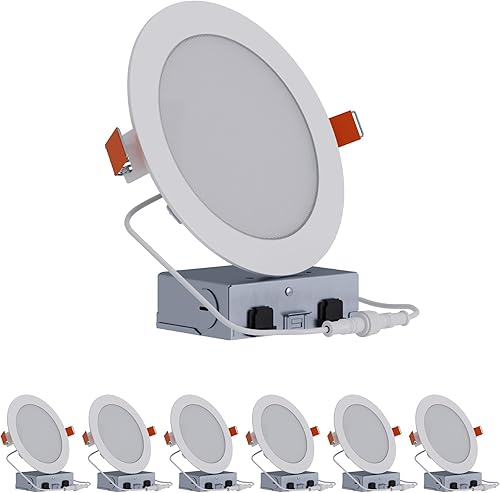
Halo HLB6 6-Pack, Selectable Lumens AND CCT
- Canless wafer · wet-rated · Energy Star · IC-rated
- Selectable lumens 600/900/1200 · ~110° beam · dim to ~5% on Caseta
- 5-CCT: 2700K / 3000K / 3500K / 4000K / 5000K
The HLB6 is on this list for one specific reason: Halo publishes the cleanest, most-tested dimmer-compatibility chart in the wafer category, by a wide margin. The chart explicitly names tested behavior on Lutron Caseta, Diva CL, Maestro CL, Skylark CL, Leviton Decora Smart, several Leviton ELV models, and a handful of legacy TRIAC dimmers with notes on expected flicker. For the buyer who’s actually worried about dimmer pairing, the HLB6 is the lowest-risk wafer on Amazon — not because the driver is magically better, but because the published data lets you check your pairing before you commit to a ceiling full of fixtures. Pairs cleanly with Caseta to a ~5% dim floor. Driver is among the quietest in this class.
Watch out for. First, on a pre-2015 non-CL Lutron Diva (TRIAC), expect 120Hz flicker in the bottom 30% of the dim range and a dim floor that holds around 30% instead of the spec’d 5%. The fixture is fine. The dimmer needs replacing — and the matched-set fix is the Lutron Caseta starter kit one circuit at a time. Second, Halo’s chart calls out a known buzz issue when more than six HLB6 units are loaded onto a single Caseta dimmer at low brightness — split larger banks across two dimmers. Third, the 5-CCT switch on the back is fiddly with the fixture installed; set lumens and CCT before clipping into the ceiling.
Pick 2 — Lithonia Lighting WF6 LED Wafer Downlight
Best for fresh smart-dimmer installs when quietest-driver matters — the build-quality premium pick.

Lithonia WF6 Wafer Downlight, 90 CRI
- Canless wafer · IC-rated · wet-rated · 5-yr warranty
- 13W · ~1050 lm · 90 CRI · dim to 10% spec, ~5% real on Caseta
- 3-CCT: 3000K / 4000K / 5000K · Energy Star · JA8 / Title 24
The WF6 has the quietest driver of any wafer we’ve tracked, which is the spec that matters most when “dimmable” is the buyer’s actual question. Audible buzz from the wall plate at low brightness is the second most common dimmer complaint after flicker, and it’s almost always driver-side — Lithonia’s commercial-grade driver build runs essentially silent across the dim range. Pairs cleanly with Caseta and Leviton Decora Smart down to ~5%. The 5-year warranty is the longest in the wafer category and it’s meaningful here: driver failure (not LED failure) is what kills dimming performance over time, and the warranty actually covers the driver.
Watch out for. First, Lithonia’s published compatibility chart is solid for Lutron and Leviton but thin on Kasa and the cheaper smart-dimmer brands — if you’re committed to a TP-Link Kasa setup, get Pick 1 (Halo) instead, which has wider published data. Second, no 2700K option. The warmest setting is 3000K — fine for dimming aesthetics, but you can’t color-match into an adjacent 2700K room without a visible step. Third, per-unit cost is 2–3x what Sunco-tier wafers run; at ten or twelve fixtures the premium adds up.
Pick 3 — TORCHSTAR 5/6” LED Retrofit Downlight, 12-Pack
Best for the legacy-dimmer retrofit buyer — TORCHSTAR’s chart is the most honest about how its fixtures behave on old TRIAC.

TORCHSTAR Retrofit 12-Pack, E26 + 5-CCT
- Retrofit only — fits existing 5"/6" cans (E26)
- 15W · 1100 lm · CRI 90+ · ~90° beam · dimmable
- 5-CCT: 2700K–5000K · Energy Star · IC-rated
The retrofit buyer profile maps almost perfectly to Bucket D1 — homeowners upgrading bulbs in existing 5”/6” cans usually have a 2005–2015 dimmer in the wall and aren’t replacing it. TORCHSTAR’s published compatibility data on legacy TRIAC is more honest than most: the chart explicitly notes which TRIAC dimmers produce visible flicker and at what percentage of the dim range, rather than the generic “compatible with most dimmers” claim that gets buyers in trouble. CRI 90 holds up in independent measurement, which matters because dimming a low-CRI fixture exposes color rendering problems that are hidden at full brightness.
TORCHSTAR is also our top retrofit pick over the kitchen prep counter — see the kitchen guide for the CRI-and-food-color reasoning.
Watch out for. First, retrofits sit inside an enclosed can and run hotter than canless wafers. Driver heat is the long-term enemy of dim-curve stability — the dim floor will rise from ~10% to ~25% over 3–5 years in a poorly-vented can. The fixture didn’t get worse; the driver is hotter. Second, on non-CL Lutron Diva (pre-2015 TRIAC), expect flicker in the bottom 25% of dim range — TORCHSTAR’s chart says so explicitly. Treat that as a hard signal to swap the dimmer for Diva CL or Caseta rather than to return the fixtures. Third, pairing two different retrofit brands on the same dimmer (TORCHSTAR plus a generic Sunco BR30, say) is the most common dimmer-on-one-circuit failure mode. Don’t mix.
Pick 4 — Lithonia LDN6 6” Commercial Downlight (0-10V)
Best for commercial-grade flicker-free dimming to near-zero — the answer when consumer wafers aren’t enough.
Lithonia LDN6 Commercial Downlight (0-10V)
- 6" commercial downlight · steel housing · IC + damp-rated
- 1200–1500 lm · 90 CRI · 0-10V driver standard · dim to <1%
- 3000K or 4000K fixed · commercial 5-yr warranty
This is the pick for the buyer who genuinely wants flicker-free dimming to near-zero and is willing to pay for it. 0-10V commercial-grade dimming is the only path to true smooth dim-to-1% on an LED fixture — phase-cut dimmers (whether TRIAC or ELV) cannot get there, because the driver electronics impose a floor. The LDN6 line is the Lithonia commercial standard, used in office build-outs and restaurant fit-outs across the US. Build quality is meaningfully above the consumer WF6, drivers are quieter, and the 5-year commercial warranty actually covers driver failure (the consumer warranty often doesn’t). Pair with any 0-10V wall control — Lutron Diva 0-10V (DVTV) is the common choice.
We link to the Amazon search results rather than a single ASIN here because commercial Lithonia moves primarily through electrical-supply distributors (Graybar, Rexel, Cooper), and the Amazon stock on the LDN6 family is inconsistent week to week. The search routes you to whichever LDN6 variant is in stock today, with comparable Halo LCR6 and Cooper commercial alternates surfacing as backups.
Watch out for. First, a separate 0-10V low-voltage control wire has to be pulled to every fixture. This is a wiring decision made at rough-in, not at fixture-buy. If you’re asking the question after drywall is up, 0-10V is off the table for this room — go to Pick 1 or Pick 2 with Caseta and accept the ~5% floor. Second, per-fixture cost is 2–3x a consumer wafer, and a six-fixture room is real money. Third, Amazon stock is inconsistent. Plan to substitute through electrical-supply if the search results come back thin on the day you order.
Pick 5 — Halo HLB6 Warm-Dim Variant
Best for the dim-to-warm aesthetic — the only honest answer to “I want my LEDs to feel like the old incandescents when I dim them.”
Halo HLB6 Warm-Dim Variant
- 6" canless wafer · IC + damp-rated · Energy Star
- ~10W · 600–900 lm · CRI 90 · dim to ~5% on ELV / CL
- Dim-to-warm: 3000K @ 100% → 2200K @ 5%
The dim-to-warm spec is the only honest answer to “I want my LEDs to feel like the old incandescents when I dim them for dinner.” Without it, an LED at 10% dim is still 3000K — just dim, not warm — and the eye reads that as cold or wrong compared to memory of tungsten dimming. Halo’s dim-to-warm wafer shifts to 2200K at the bottom of the curve, which is essentially incandescent territory and reads as cozy in a dining room or living room. Pairs cleanly with Caseta or Diva CL. The buyer who specifically asks for “warm dimming” is asking for exactly this fixture.
We link to a search URL rather than a hard ASIN because the Halo dim-to-warm SKU set is small and Amazon stock churns weekly. The search routes you to whichever Halo warm-dim wafer is live today; if Halo is dry, Juno Trac-Lites Warm Dim or TCP Warm Dim are credible same-category alternates that may surface in the same results.
Watch out for. First, roughly 2x the price of the standard HLB6. Specialty SKU, lower volume, premium pricing. Second, stock churn — dim-to-warm SKUs move in and out of Amazon stock weekly. Plan a search-URL fallback. Third, don’t mix warm-dim with standard wafers on the same dimmer. If half the ceiling is warm-dim and half is standard, the dimmed scene reads as visibly mismatched — the standard half holds 3000K while the warm-dim half slides to 2200K, and the eye picks it up immediately.
Pick 6 — Philips Wi-Fi Wiz 5”/6” Color + Tunable White Recessed Kit, 4-Pack
Best for the smart-dimmer-paired tunable-white buyer — scenes from the app, no wall dimmer in the loop.

Philips Wi-Fi Wiz 5"/6" Recessed Kit, 4-Pack
- 5"/6" canless recessed kit · ETL · Alexa + Google
- 65W equivalent · color + tunable white · dimmable
- Wi-Fi 2.4 GHz (no hub) · Wiz app scene support
For Bucket D5 the dimming question is different: you’re not pairing a fixture with a wall dimmer at all. The wall switch stays at full on, and the fixture dims itself via app or voice command. Tunable white is the actually-useful smart feature — “evening” at 2700K dimmed 40%, “task” at 4000K full output, “movie” at 2200K dimmed 10%, all one tap away. RGB ships with the kit but isn’t the point. The Philips Wiz line is the credible non-Lumary path on Amazon: same parent brand as Hue at a lower price tier, no hub purchase, scene programming in the app, and a 4-pack covers a small zone on a single SKU instead of forcing a multi-brand split.
Watch out for. First, the Wiz app is not the Hue app. Buyers consistently report occasional re-pairing required after router reboots, and the scenes UI is fiddlier than the screenshots imply. If you already live in Hue, you’ll be frustrated; if you’re new to smart lighting, Wiz is fine. Second, 2.4 GHz Wi-Fi only. Modern mesh networks that auto-steer between bands cause setup pain — the fixture won’t pair when the phone is on 5 GHz. Pin the phone to 2.4 GHz during pairing, then switch back. Third, CRI on tunable-white mode lands around 80, not 90. Adequate for ambient zones and scene use, not for a primary prep counter — pair these with Pick 1 or Pick 2 over zones where color accuracy matters.
Common dimmer failure modes — how to diagnose them
Reading review patterns across the dimmable-LED category, the same seven failure modes show up over and over. None of them are stupid mistakes — the category doesn’t surface these distinctions clearly, and the listings are written to hide most of them.
1. Visible flicker on slow-motion video. The eye sees flicker at 60–120Hz as a faint shimmer; a phone camera in slow-mo captures it cleanly as horizontal banding rolling across the fixture. If you’re unsure whether your lights flicker, point your phone’s slow-mo at the ceiling for five seconds. Almost always a TRIAC dimmer driving an LED load. Fix: replace the dimmer with ELV, CL, or smart.
2. Buzz or hum from the wall plate — not from the fixture. Audible at low-to-mid brightness, louder at the bottom of the dim range. It comes from the dimmer’s choke coil reacting to the LED driver’s switching pulses. Buyers walk to the fixture looking for the buzz; the buzz is in the wall. Fix: replace the dimmer with ELV or smart.
3. Dim floor higher than spec. Listing says “dim to 10%” but the light snaps off (or holds steady) at 30–40%. Almost always a TRIAC dimmer’s minimum-load problem — the LED draws too little current at the low end and the dimmer drops out. Fix: replace the dimmer, or increase load by adding more fixtures to the circuit.
4. Drop-out at low brightness. Light snaps fully off below ~20% rather than dimming smoothly to the floor. Same root cause as #3 but more abrupt — the dimmer’s low-end-detect circuit gives up entirely. Fix: same.
5. Visible CCT shift at dim — without a dim-to-warm spec. Light appears to shift color (often cool-to-pink or cool-to-green) as it dims. This is the LED phosphor mix responding to reduced driver current — the blue pump LED dims faster than the phosphor emission, and the un-converted phosphor color leaks through. Only fixtures with an explicit dim-to-warm spec are supposed to shift color; everything else holding 3000K and drifting pink is a driver-quality issue. Fix: replace the fixture (not the dimmer) with a higher-grade driver.
6. Phantom illumination at “off.” The fixture glows faintly when the dimmer is fully off. The dimmer is leaking ~1–2W of standby current through the LED driver — enough to keep the LED at a perceptible glow. Almost always a smart dimmer or an old electronic dimmer leaking through. Fix: a physical switch in series upstream, or replace the dimmer.
7. Pairing two different fixture brands on one dimmer. Each LED driver has its own dim curve and minimum load. Two brands on one dimmer dim at different rates and reach the floor at different points — you get a visibly mismatched ceiling. Buyers do this because they ran out of one brand mid-install and grabbed a different brand to finish. Fix: one brand per dimmer circuit. If you must mix, dedicate a dimmer per brand.
Quick recommendations by dimmer scenario
- If you have a pre-2015 Lutron Diva (non-CL) in the wall and you’re not replacing it: Pick 3 (TORCHSTAR retrofit) if you have existing cans, or Pick 1 (Halo HLB6) if the ceiling is open — Halo’s compat chart tells you exactly what flicker behavior to expect on legacy TRIAC.
- If you have a pre-2015 dimmer AND you’re willing to replace it: the Lutron Caseta starter kit paired with Pick 1 (Halo HLB6) or Pick 2 (Lithonia WF6) is the gold standard. This is what we’d install.
- If you’re putting in Caseta or Leviton Decora Smart fresh and the drywall is open: Pick 2 (Lithonia WF6) for the quietest-driver premium build, or Pick 1 (Halo HLB6) for the most flexible spec sheet.
- If you want commercial 0-10V smooth dim to near-zero: Pick 4 (Lithonia LDN6) with a 0-10V wall control. Plan the low-voltage control wire at rough-in.
- If you want incandescent dimming feel — warm glow at low brightness: Pick 5 (Halo dim-to-warm). Pair with Caseta or Diva CL. Don’t mix with standard wafers on the same dimmer.
- If you want app-driven scenes: Pick 6 (Philips Wiz). Tunable white is the useful smart feature; skip the RGB.
- For California new construction: Pick 2 (Lithonia WF6) is the only JA8-compliant fixture on this list.
For new construction or the head-term list of ten picks across all six install buckets, see our main recessed lights guide.
This guide gets you to the right fixture for the right dimmer. It doesn’t yet cover the wiring side — neutral-vs-no-neutral switch boxes, multi-way dimmers, and the specific 0-10V control runs for commercial installs. That’s a separate post we’re working on. If you’re stuck on a wiring question before you commit, drop it in the comments and we’ll prioritize the one that comes up most.
Buy honest. Match the dimmer to the fixture, not just the fixture to the room. And if the lights flicker after a clean install — check the dimmer first.